
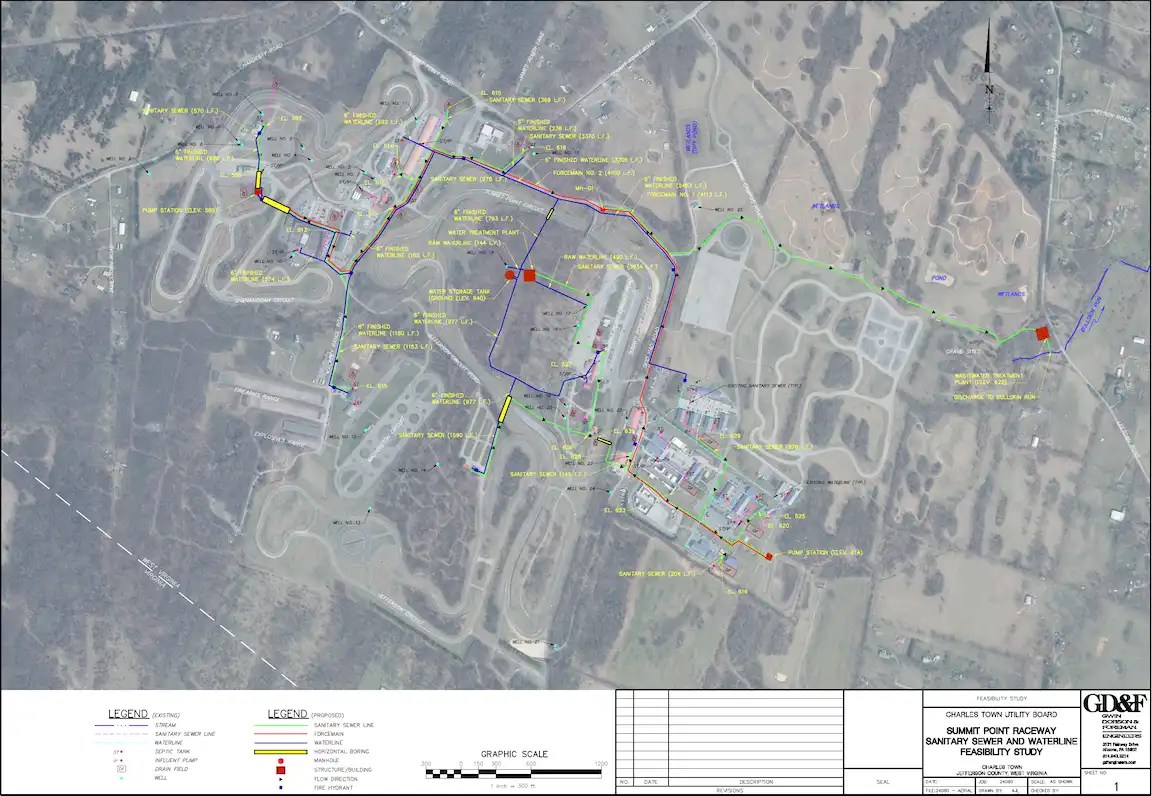
The concept plan (above) included in a July 2025 feasibility study provides a general layout for a water and sewer system in Summit Point.
The company operating the Summit Point Motorsports Park and Training Facility (SPMP/TF) says it needs a “stable, reliable, water and sewer solution” to maintain current operations and support future expansion, according to a presentation provided to the Charles Town Utility Board (CTUB) in early 2025.
A Large Complex In Summit Point
The motorsports park and training facility occupies a 717 acre property located south of the village of Summit Point in Jefferson County WV. The property is owned by Summit Point Automotive Research Center, LLC. The property spans 11 separate parcels, all of which were rezoned from rural to commercial in 2022.
A separate company, Summit Point Raceway Associates (SPRA), operates several subsidiary businesses at the facility, including Summit Point Motorsports Park, Summit Point Training Facility, and Summit Point Solutions. SPRA also leases space at the park to other companies.
According to the motorsport park’s website, the Summit Point facility started as a racetrack constructed in 1969. During the 1970s it hosted IMSA and SCCA racing events. The facility has hosted several government training programs since the 1980s, initially focused on driving skills and eventually expanding into firearms and other training.
The current owners acquired the property in 2022 as part of a corporate restructuring.
CTUB Responds To A Request For Service
In early 2025, CTUB retained Gwin, Dobson & Foreman Engineers (GD&F) at the request of SPRA to survey the Summit Point site and assess the feasibility of constructing a central water and wastewater treatment system. According to the report GD&F presented to CTUB and SPRA in June 2025, the scope of the assessment project was to “establish the number, type, and current condition of on-lot disposal systems and to identify potential sources of contamination to existing and proposed drinking water systems throughout the campus. The findings will also support the feasibility assessment for developing new centralized water and wastewater treatment systems to serve current and future needs reliably.”
A Preliminary Cost Estimate
In the feasibility study, GD&F included a “planning cost estimate” for a centralized system on the Summit Point site, ballparking the project cost between $7.7 and $10.7 million (table below). Chris Eckenrode, the licensed engineer who oversaw the GD&F study, emphasized during the report presentation and at follow-up meetings that these preliminary estimates would need to be revisited once a specific engineering plan for the site is developed and final requirements for the project are defined.

GD&F provided a more detailed breakdown of its planning cost estimate to CTUB staff in December 2025.
A Concept Plan For Discussion
The feasibility study included a concept plan of the site (map image below) showing potential locations for the treatment facilities as well as the network of pipes to connect the existing buildings on the site. The planning budget included in that study includes an allowance of $3 million for future expansion.
The Initial Path For Funding
In December 2025, CTUB applied to the West Virginia Water Development Authority for a grant that offered the potential to fund the entire cost of the design, engineering and construction of a water and sewer system in Summit Point. At the time, CTUB expected the grant amount would be $10.6 million with no requirement for local funding, based on assurances from the state entities involved in the process.
However, according to information provided to the CTUB board at its January 28 meeting, the state received more applications than expected for the grant fund, so the grant amount available to CTUB for this project was reduced to $4 million.
Looking At Local Funding Options
Following discussion at the January 28 meeting about financing options, including revenue bonds and a TIF district, the CTUB board requested the utility staff to prepare financing options for it to consider at its next meeting.
The information presented by the CTUB staff at the next board meeeting on February 11 were light on the details necessary for the board members to evaluate the project. The missing information includes:
A specific development plan for the site — The planning budget includes $2.7 million for the network of pipes to supply water and collect sewage. Without a master plan for the site, a significant amount of this investment could end up needing to be replaced or modified as the site is developed.
Data on demand, both current and future — The financial projections provided for the project (see charts below) make assumptions about both current and future usage. The planning budget allocates over $4 million for the core water and treatment systems, with another $3 million in future expansion. Without specific commitments from SPRA, the utility is at risk of building a facility that is too big to cover its costs or too small to meet the demand.
The property owner’s contribution to the project — Last fall, SPRA indicated a willingness to cover some of the project costs in excess of the $10.7 million that was expected from the state. Now that the state has reduced its commitment, SPRA has not yet announced any commitments to invest in this project.
CTUB Discussions Ongoing
During the February 11 meeting, the CTUB board members voted unanimously to “reaffirm its prior support for providing water and wastewater services to the Summit Point Motorsports Park project, as previously contemplated under a State-funded structure.” The CTUB board also voted to issue a request for proposal (RFP) for an engineering firm to prepare a more detailed analysis of the proposed project.
The City of Charles Town has the project on its February 17 agenda for discussion. Absent any specific financing request or project details from CTUB, it is unclear whether they can take any action at this time.
A Look At The Numbers
The charts below summarize the financial projections provided by the CTUB staff at the February 11 meeting. The information was provided in several documents without footnotes or detailed explanation.
The charts below, created by The Observer from the information presented at the February 11 meeting, include headings and notes to enhance the clarity of the information.
UPDATE 2026 Feb 20 — Revised “Analysis of Debt Service” documents prepared by the accounting firm J.C. Kunkle and Associates were included in meeting packet for the February 17 Charles Town City Council. Those documents, noted as “February 13 Revision 1” included both the water and sewer revenue in the analysis. There was also an addtional “Analysis of Debt Service” projection based on CTUB’s current standard tariff rate, rather than the reduced contract rate used in the earlier projections. The Observer’s charts below already included the combined revenue from water and sewer. An new chart incorporating the revenue projection based on the standard tariff is included below.
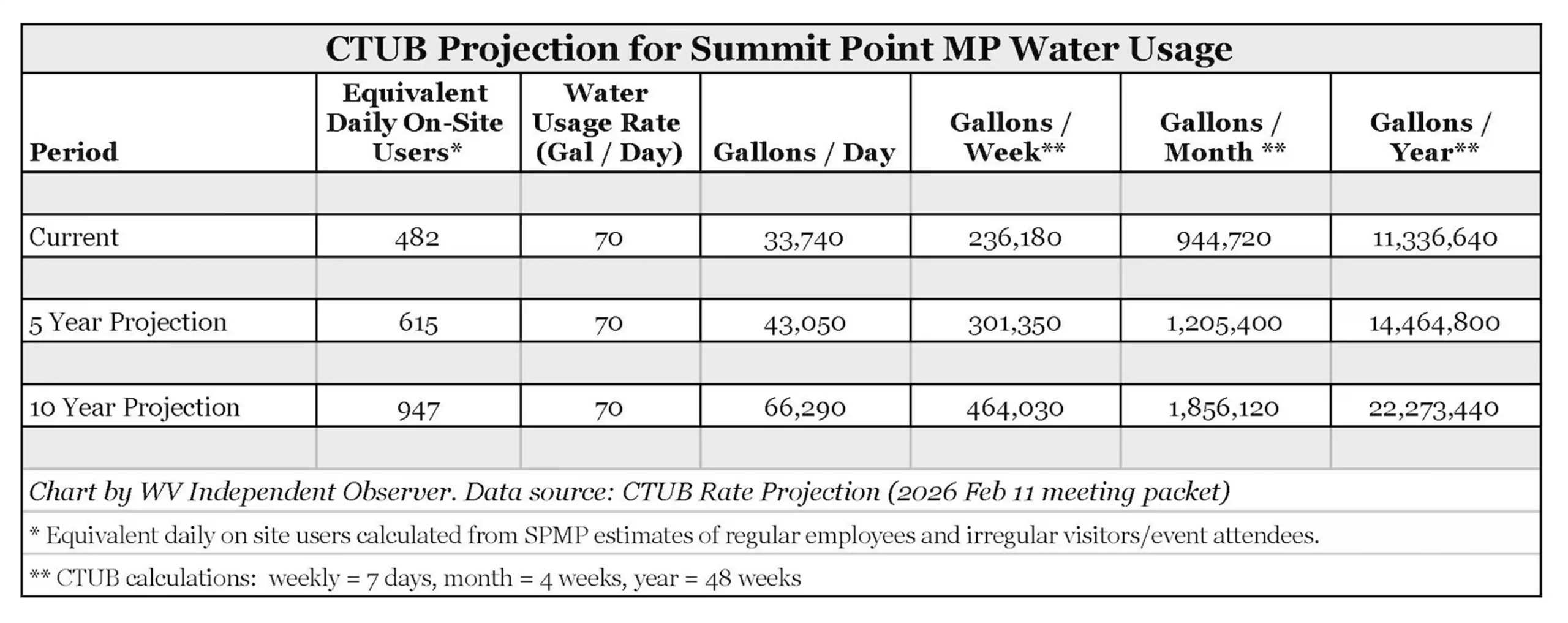
The estimate of current users on the site is a composite number based on the employees working on site daily, weekday visitors, and weekend event participants. The 70 gallons per person per day usage rate is typical of residential use. Office/commercial water use is typically 15 – 20 gallons per perrson per day according to data published by the U.S. Energy Information Administration.

The estimate of revenue the project will generate is a function of how the user base will expand, how much water those users consume, and the rate negotiated between the utility and the customers on the site. In the February 11 meeting packet, the financial projections prepared by CTUB staff did not include the revenue from both the water and sewer usage.

CTUB staff provided debt service projections for both a $3 million and a $6 million bond. The table for the $6 million bond schedule (above) and the $3 million bond schedule (below) were compiled from documents provided by CTUB on February 11. The feasibility study projected a 5 year design and construction period, so the revenue stream is calculated assuming the project generates revenue beginning in year 5.

The project as currently defined is cash-flow negative for both the $6 million and $3 million scenarios using the CTUB revenue projections. If the project schedule is accelerated and revenue stream begins earlier, the project would still be cash flow negative during the 25 year of bond service.
Debt Service Analysis With Standard Tariff Revenue
The charts below were compiled based on information included in the packet for the February 17 Charles Town City Council meeting.

The standard CTUB water tariff has three rate tiers (based on gallons per month) and the sewer tariff has two tiers. Calculating the projections with the standard tariff shows significantly more revenue compared to the contract rate used in the initial CTUB projections. The rates shown for the 5 and 10 year projections assumes that rates increase 3.4% annually.

The chart above assumes project revenue begins in year 2 to align with the debt service numbers indicated in the documents provided to the Charles Town City Council. Even at the higher standard tariff rate, this projection using the CTUB numbers indicates the project is cash flow negative until year 18 and the accummulated deficit is more than $3 million over the term of the bond.
Interpreting The Analysis Of Debt Service Document
The estimates of the $3 million and $6 million bond repayment schedules in the tables above are from the”Analysis of Debt Service” document prepared by the accounting firm J.C. Kunkle and Associates that was presented at the February 11 CTUB meeting. That document includes notes that the “Summit Point project is financially feasible,” that the project would require the use of operating reserves to cover the debt service, and that projected customer [revenue] increases would mitigate use of annual operating reserves. As explained by the accountant, those notes refer to the overall capacity of CTUB to support a debt stream of this magnitude rather than any opinion about the financial viability of the specific project.
In other words, the accountant’s “Analysis of Debt Service” indicates it is possible for CTUB to service a $3 million or $6 million bond under the proposed scenarios because it has enough revenue accumulated from other projects to cover any shortfall from the proposed project. The accountant’s note about financial feasibility applies to CTUB as an operating entity rather than an opinion about the merits of the specific project.
Published 2026-02-17. Updated 2026-02-18 (captions, debt analysis note). Updated 2026-02-19 (meeting chronology). Updated 2026-02-20 (added debt service analysis charts based on information provided to the Charles Town City Council).
By Steve Pearson